Thursday, January 24, 2013

Hydraulic Pressure Equation

Introduction to hydraulic pressure equation

The hydraulic pressure means the pressure exerted due to a liquid column. The pressure of a liquids is defined as the amount of normal force acting per unit area on the surface. Hydraulic pressure is a scalar equation and the unit of hydraulic pressure is Newton per square metre.

Let us assume that F be the normal force acting on a surface of area A in contact with liquid, then hydraulic pressure exerted by the liquid on this surface is P = F /A. Hydraulic pressure is a scalar quantity because at one level inside the liquid, the pressure is exerted equally in all directions, which shows that a definite direction is not associated with hydraulic pressure. Please express your views of this topic Torque Problems by commenting on blog.

Derivation for Hydraulic Pressure Equation

Consider a liquid of density d contained in a cylindrical vessel of cross sectional area A. let h be the height of liquid column, and g be the value of acceleration due to gravity. The weight of liquid will exert a downward thrust on the bottom surface of the vessel. Therefore, pressure due to liquid acts on that surface. Is this topic capacitor electrolytic hard for you? Watch out for my coming posts.

Weight of liquid inside the vessel = volume × density of liquid × acceleration due to gravity

= Ah × d × g

Thrust of liquid on area A = weight of liquid = Ahdg

Hydraulic pressure on the base of vessel = P = Thrust / Area = Ahdg / A = h d g

Hydraulic Pressure = Height of the liquid column × density of liquid × acceleration due to gravity

Example for Hydraulic Pressure Equation

A 60 kg girl wearing high heel shoes balances on a single heel. The heel is circular with a diameter of 1.5 cm. Find the pressure exerted by the heel on the horizontal floor?

Solution

Here, m = 60 kg, r = D / 2 = 1.5 / 2 = 3 / 4 cm = 3/400 m

According to the formula, Pressure = thrust / area

P = mg / `pi` r2

P = 60 × 9.8 / (22 /7) × (3/400)2 = 2.49 × 10⁴ Pa.

Thursday, January 17, 2013

Vision Problems Causes

Introduction to Vision Problem Causes

The human eye gives us the sense of sight and allows us to observe the adjacent world. We use our eyes in almost every activity, e.g. reading, working, watching television, writing a letter, driving a car, and in countless ways. Sight is the sense that is most valued as compared to the other sense organs.

The eye allows us to see various shapes, colors, and dimensions of objects in the world by processing the light.  The eye is able to sense bright light or dim light, and it is not possible to intellect objects when light is absent. I like to share this What Causes Static Electricity with you all through my article.

Problems of Vision & their Causes:

Following are the vision problems and their causes:

1) Myopia (Shortsightedness)

A person having this defect can see objects at short distance clearly but cannot see distant objects. The cause for this defect is

1. The eye ball becomes too long, so the rays coming from infinity get focussed in front of retina.

2. The focal length of the eye lens decreases. In this case also, the image is formed in front of retina when rays are coming from a distant object.

Myopia is corrected by placing a diverging lens (concave lens) of suitable focal length in front of the eye.

2) Hypermetropia (Long Sightedness)

A person with this defect can see distant objects distinctly but cannot see the near objects clearly. This defect is caused by

1) The eye ball gets too short so that image of objects is formed a little beyond the retina.

2) The focal length of eye lens increases. Because of this image is formed beyond the retina.

Hypermetropia is corrected by placing a converging lens (convex lens) of suitable focal length in front of the eye. Due to the converging lens, the rays get converged (focussed) on the retina. Please express your views of this topic Power Equation Physics by commenting on blog.

Defects of Vision & their Causes (continued)

3) Astigmatism:

In certain persons, the cornea of the eye is not absolutely spherical in shape but is distorted. It is also possible that it bulges out at certain points. Such a person suffers from astigmatism. If such a person looks at a wire gauge cross then its horizontal part will appear properly focused while the vertical one will appear blurred. So the person may be able to see in one plane but not in the other plane. Horizontal and vertical lines of a wire-gauge cannot be seen distinctly simultaneously. This defect is corrected by using appropriate cylindrical lens.

4) Presbyopia

This defect occurs due to aging. A person suffering from this defect can see neither nearby objects nor distant objects clearly/distinctly. This is because the power of accommodation of the eye decreases due to the gradual weakening of the capillary muscles and decreasing flexibility of the eye lens.

This defect can be corrected by using bi-focal lenses. Its lower part consists of a convex lens and is used for reading purposes, whereas the upper part consists of a concave lens and is used for seeing distant objects.

These days it is possible to correct these defects with the help of contact lenses or through LASIK-surgery.

Wave Propagation in Fluid

Introduction to wave propagation in fluid:
Waves are the disturbance, which travels through the medium. There are several kinds of waves. Such as mechanical waves, non-mechanical waves, electromagnetic waves, radio waves etc. The wave can propagate in two manners. The wave propagation is as follows: Transverse wave propagation and the longitudinal wave propagation. The waves, which travels or propagates in the fluid, may be transverse wave motion or longitudinal wave motion. Here we discuss the wave propagation in fluids. Having problem with Longitudinal Waves Definition keep reading my upcoming posts, i will try to help you.

Propagation of Wave in Fluid

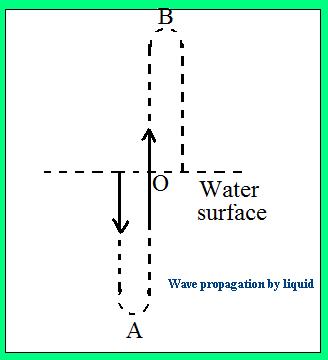
Wave motion in a fluid is the form of disturbance, which travels through the fluid due to the repeated periodic motion of the particles of the medium about their mean position, the motion being transferred from one particle to another. To understand the mechanism of the propagation of the wave on the fluid, we can explain it on the basis of the elasticity and inertia of the medium. Suppose that the stone hits the water surface at point O, which represents its mean position. As it moves downwards with the stone, due to the property of elasticity of the medium, restoring force starts acting on it. As it moves against the restoring force, its speed goes on decreasing and ultimately it comes to rest on reaching, say at point A. At this position, the energy possessed by the molecule is in the form of its potential energy. At the point A, the restoring force on the molecules is maximum and hence it starts returning to its mean position. As it does so, its potential energy converts into kinetic energy. However, on reaching the mean position O, the molecule over shoots, which is due to inertia and moves up to the point B, until the velocity attained by it at the point O, becomes zero. In this manner, molecule of the water executes periodic motion about its mean position due to the properties of inertia and elasticity. The disturbance is communicated to the neighboring molecules of the water, which also begin to execute periodic motion about their mean positions. I have recently faced lot of problem while learning Work Equation Physics, But thank to online resources of math which helped me to learn myself easily on net.


Conclusion of Wave Propagation in Fluid
We concluded that in the wave propagation of fluid, the particles of the medium oscillate only at their mean position. The particles of the medium do not travel from one point to another. Only the energy is transferred from one point to another.

Thursday, January 10, 2013

Electrical Control Techniques

Introduction to electrical control techniques:

Control is nothing but the way to do any task such that the task is being done in a prescribed and safe manner. The electrical control techniques are one of such techniques for control the use of electric energy such that the electric energy can be saved for the future generation. I like to share this Electromagnetic Spectrum Waves with you all through my article.

Now a question arises i.e. how electricity is used in controlled manner and what are the techniques for electrical control?

Some Techniques for Electrical Control:

Electrical control techniques are the techniques which are used for the controlled use of electricity in the present days such that the electric power should be prevent for the future generation. Precisely electrical control techniques are defined as control engineering used in the process of electric power saving such that these control does not affects the others. Please express your views of this topic Acceleration Problems by commenting on blog.

There are several control techniques are available but one has to choose the write technique for the electric control. Because a wrong control technique can de-save the electricity instead of saving it.

Example of Electrical Control Techniques

Electric control unit is one of the good examples of the electrical control technique. The Electronic Control Unit (ECU) is capable of driving any number of DC motors. Fig.1 shows an ECU which is capable of driving 4 independent brushless DC motor windings. It is designed for high-reliability space flight applications and is radiation hardened. This ECU contains two electrically isolated sections. The motor drive circuitry is connected directly to the 28 VDC power bus, which is isolated from chassis ground. The low-level logic circuits, including the FPGA’s and telemetry, are tied to chassis ground, and are connected to the motor drivers by high-speed optocouplers. FPGA is the heart of this electrical control unit which provide the control logic it also perform functions such as servo control, process input commands and generation of Pulse Width Modulated outputs.

Thursday, January 3, 2013

properties of waves

A wave is the disturbance produced in a medium when particles in the medium are responsible for the movement of the neighbor particles. A wave is associated with the transfer of energy. The energy transfer takes place with the help of the medium particles by their movement. It is not that the particles take energy from one point to another but they vibrate at their mean position to transfer energy to their neighboring particles. So, particle doesn’t move but it is the disturbance in the medium that moves. Having problem with Frequency Equation Wavelength keep reading my upcoming posts, i will try to help you.

According to classical atomic theory matter was considered as matter and wave is considered as wave. In 1921 Louis DeBroglie proposed a new concept which contradicted this theory. louis de Broglie was a French physicist who proposed the theory of dual wave nature. louis de broglie atomic theory proposed that electrons acts as both particles and wave. It was also proposed that electron wave in the atomic orbit is standing wave with some energy, amplitude, frequency like any other wave. A particle moving with a velocity shows a wave nature. This matter wave is known as De Broglie’s wave. His theory was named as matter wave dual theory according to which matter can behave as matter and wave and wave behaves as matter and wave. The wavelength of matter wave is given by:
λ = h/ p
Or λ = h/mv
Here, h is plank’s constant, p is momentum of the matter, m is its mass and v is velocity. Wavelength of the wave is known as De Broglie’s wavelength. Please express your views of this topic Instantaneous Velocity Formula by commenting on blog.

Properties of Waves include wavelength, frequency, Amplitude time period.
Description of above Wave Properties is as follows:
Wavelength of a wave is the distance between consecutive crests or troughs. It is denoted by letter λ.
Amplitude of a wave describes the strength or energy of the wave. It is the maximum displacement of the crest from the rest position of the wave. It is also equal to the maximum depth of the troughs of a wave. Amplitude of a wave decides the energy of it. Larger the value of A, larger is the energy of wave.
Frequency of a wave means how many times the crest or troughs appear in unit time or in one second. It is denoted by f. unit of frequency is hertz or Hz.
Period of a wave is the time required for two consecutive crests or troughs to appear. It is denoted by T.
Time period and frequency are related as: T = 1/f.

Thursday, December 20, 2012

Binding Energy Carbon

Introduction to binding energy of carbon:

To begin with a discussion on binding energy of carbon, let us begin with the atom of carbon. Carbon atom has six electrons, six neutrons and six protons. A carbon atom combines with another carbon atom by forming a bond between them. These bonds are necessary for the existence of carbon molecule and for different chemical reactions. It is one of the elements, which is fond the most naturally. The quantity of energy that is required to haul the proton and neutron apart considerably is known as binding energy. Let us study carbon’s binding energy in detail. Having problem with Atomic Mass Carbon keep reading my upcoming posts, i will try to help you.

Description of Binding Energy of Carbon

The distance between the centers of the atoms bonded together is called as the bond length. Bond order is the electron pair number. These electron pairs are shared between the atoms for forming bonds. In case of carbon-carbon bond, the bond order is 2. In order to break the bond between the carbon-carbon bonds, the binding energy between the two atoms needs to be countered. The energy required to break the bond is called bond dissociation energy or bond energy. Generally the bond lengths between the atoms of a particular element remain the same. As the lengths are the same, the bond energy also remains the same.

Studies shows that the shorter the bond length, the higher the binding energy.  The following is a table of different substances, including carbon. Please express your views of this topic Basic Physics Formulas by commenting on blog.

The table gives a comparison of the bond lengths and binding energies of the different elements and molecules of compounds.

                                                Table of bond lengths and binding energies

Conclusion for Carbon’s Binding Energy

From the discussion made on binding energy of carbon, binding energy of carbon can also be defined as the enthalpy change on a reaction to break the bonds. The binding energy between the carbon atoms exists due to the C-C bond. These are covalent bonds which are formed by equal sharing of electrons.

Marie Curie Radioactivity

Introduction to Marie Curie radioactivity

The study of nuclear physics began when Becquerel discovered radioactivity in 1869, just one year after the discovery of X-rays. He found that accidentally, that an ore containing uranium emits an invisible radiation that can penetrate a black paper wrapper and expose a photographic plate. The rays are called as radioactive rays. Madam Marie Curie and her husband Pierre Curie conducted the most significant investigation in the field of radioactivity. After several years of careful and the laborious chemical separation process on tons of pitchblende, a radioactive ore, the Marie Curie reported the discovery of two previously unknown elements, both of them were radioactive. These were named polonium and radium. Madam Marie Curie was awarded Nobel Prize in 1903 for the discovery of radium. I like to share this Curie Law with you all through my article.

Marie Curie Radioactivity

Radioactivity is the spontaneous phenomenon exhibited by the heavy elements only. It is the property of the heavy elements, which disintegrates itself without being forces by any external agent. The total number of radioactive elements known at present is about 40. The natural elements with atomic number more than 82 are all radioactive, for example, Radium, Thorium, Actinium, Polonium etc. The phenomenon of radioactivity is not affected by pressure, temperature, chemical changes etc. The electrons orbiting around the nucleus are not responsible for the phenomenon of radioactivity. Please express your views of this topic Instantaneous Velocity Equation by commenting on blog.

Laws of Marie Curie Radioactivity

The laws of Marie Curie radioactivity are as follows:

(i) Radioactivity is a spontaneous process, which does not depend upon external factors like temperature, pressure etc.

(ii) During disintegration of an atom, either an alpha particle or a beta particle is emitted. Both of these particles are never emitted simultaneously. At a time, an atom will not emit more than one alpha particle or more than one beta particle.

(iii) The emission of alpha particle from an atom will change it into a new atom whose mass number is reduced by 4 and the atomic number be reduced by 2.

(iv) The emission of beta particle from an atom will change it into a new atom whose mass number remains same and the atomic number be increased by 1.